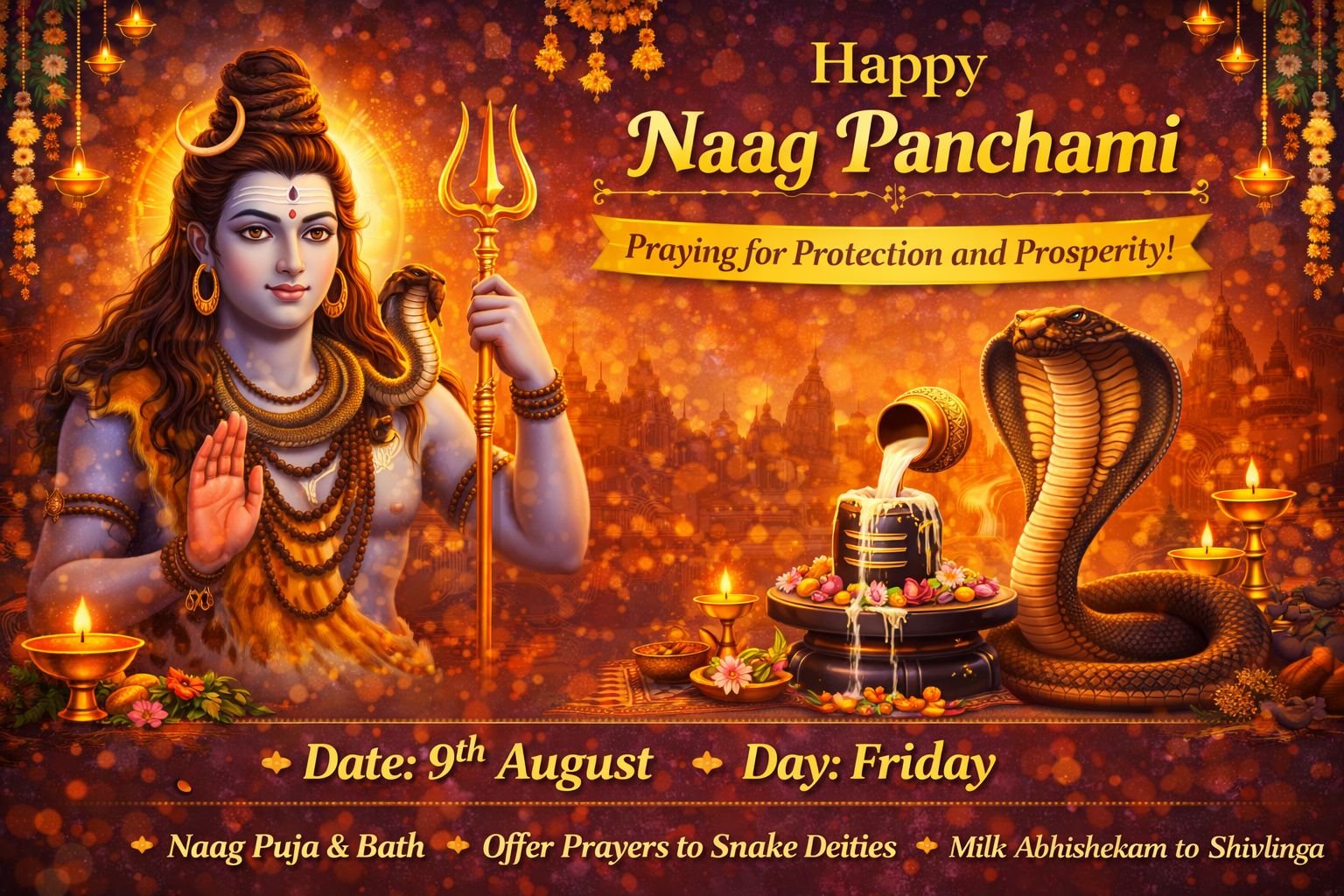
🐍 What Is Naag Panchami?
Naag Panchami is more than a festival—it’s an ancient calling. A quiet message carried through generations, reminding us:
the serpent is not a threat—it is a forgotten guide.
Observed on the fifth day of Shravana’s bright lunar phase (July–August), this sacred day venerates the Naags—serpentine beings who appear throughout world cultures as guardians, teachers, and symbols of transformation. From Himalayan ponds to stone temples across India, Naag Panchami marks a moment when myth, nature, and human consciousness intersect.
But beneath the rituals of milk, flowers, mantras, and offerings lies a deeper truth:
Naag Panchami is really about YOU.
It’s about awakening the ancient energy coiled at the base of your spine.
It’s about reclaiming intuitive, primal wisdom modern life forces us to forget.
It’s about remembering that the deepest truths were never lost—they’ve been resting within us all along.
✨ The Third Eye: Seeing the Serpent Differently
In much of the world, snakes inspire fear. Yet through the Third Eye—the gateway of inner sight—they become symbols of profound power.
Through this higher vision, the serpent appears as:
- A keeper of Earth’s oldest memory
- A catalyst of awakening
- A sentinel between the physical and the unseen
It’s no accident that Shiva wears a cobra, Vishnu reclines upon Shesh Naag, or that child-Krishna dances on Kaliya’s raging hoods without fear.
The serpent has never been merely an animal. It has always been a metaphor—
a symbol of Kundalini, the dormant spiritual energy coiled at the spine.
In yogic philosophy, when this energy rises through the chakras, it activates clarity, compassion, intuition, and transcendence. Naag Panchami, therefore, is not just a festival—it is a ritual of inner ignition.
Just as the serpent sheds its skin, we too are called to release our old layers of ego, fear, and illusion.
📜 Legends of Coil & Flame
Myths about serpents are not outdated tales—they are symbolic maps of the psyche and spirit.
• Janamejaya & the Sarpa Satra
After King Parikshit is killed by Takshaka, his son seeks vengeance through a ritual meant to annihilate all serpents. Only Sage Astika intervenes and halts the destruction.
Lesson: Rage blinds; revenge destroys. Only wisdom breaks cycles of violence.
• Krishna & Kaliya Naag
Krishna represents your awakened self.
Kaliya is your fear, ego, and illusion.
Either you rise and dance above them—or you are consumed by them.
• Shesh Naag & Vishnu
Time is coiled. Reality rests upon deeper forces we seldom perceive. Shesh embodies cosmic cycles—creation, preservation, dissolution.
• Vasuki & the Churning of the Ocean
Transformation always begins with tension. Poison surfaces before nectar.
Even danger has divine purpose.
• Manasa Devi
The serpent goddess worshipped in Nepal, Bengal, and the Northeast represents protection, healing, wisdom, and fierce motherly love. Her son Astika saves the serpent clans, showing that lineage alone doesn’t grant greatness—inner virtue does.
Each of these stories is a blueprint of consciousness, encoding lessons about growth, ego, duty, and awakening.
🛕 Sacred Sites: Where Serpent Power Lives On
🇳🇵 NEPAL
Nag Pokhari (Kathmandu):
A 17th-century pond containing a golden Naag idol—an anchor of ancestral memory. Every Naag Panchami, thousands gather here with offerings.
Taudaha & Nagdaha Lakes:
Believed to house serpent kings like Basuki and Karkotak. Farmers still pray here for rainfall and fertile crops.
Budhanilkantha (Shesh Narayan):
Vishnu resting on Shesh Naag. Historically, Nepali kings avoided visiting due to an old prophecy of death—mysterious, symbolic, or simply true.
Hidden Ritual: Near the entrance, beneath a sacred fig tree, offerings are quietly made to the Serpent Lords for wealth, protection, and well-being—an often overlooked but powerful ritual spot.
Changu, Ichangu, Bisankhu & Shesh Narayan:
Four sacred Vishnu shrines linked to the serpents who guard the Valley.
🇮🇳 INDIA
Nagvasuki Temple (Prayagraj):
Devotees come to balance karmic disruptions—especially those connected to serpent energies.
Bhujang Naga Temple (Gujarat):
A tribal-rooted serpent shrine famed for its intense, fiery celebrations.
Kaliya Ghat (Vrindavan):
Where Krishna transformed venom into harmony—teaching us that darkness is not destroyed but transmuted.
Manasa Devi Shrines (Bengal & Northeast):
Goddess of serpents, miracles, and protection—deeply revered by women and marginalized communities.
🌍 WORLDWIDE
From Fiji to Bali, Mauritius to Trinidad, serpent worship survives beneath layers of colonial erasure and cultural forgetting.
Yet it endures—like the serpent itself.
🧠 Symbolism: What the Snake Really Signifies
| Symbol | Meaning |
|---|---|
| 🐍 Shedding Skin | Continual rebirth; evolution of identity |
| 🌊 Water Dweller | Depth, emotion, the subconscious |
| 🔁 Coiled Body | Cycles of time, karma, and spiritual growth |
| 🧬 Venom | Duality: poison and medicine |
| 🕉️ Kundalini | Your primal inner energy |
The serpent is energy. The serpent is you.
🌱 Ecological Wisdom Behind the Festival
Naag Panchami is also ancient environmental knowledge:
- Monsoon brings snakes to human spaces; the festival taught coexistence.
- Snakes control rodent populations—protecting crops and preventing disease.
- Many temples now promote eco-friendly rituals and prohibit harmful milk offerings.
It’s not outdated. It’s ecological intelligence far ahead of its time.
👁️ The Third Eye View: Awakening the Inner Serpent
Ask yourself:
- Do you feel stuck? That’s your Kaliya.
- Do you fear your own strength? That’s your sleeping Kundalini.
- Do you resist change? That’s the old skin refusing to fall away.
Naag Panchami whispers:
“You are coiled potential.”
Every chant and offering is a reminder that:
- The Naag is your spinal energy.
- Kaliya is your ego.
- Sarpa Satra is your inner conflict.
These myths are not external stories—they are your inner mythology.
🕰️ Serpents Through Time: A Quick Timeline
- ∞ Cosmic Time: Shesh Naag upholds the universe
- Satya Yuga: Vasuki aids in the cosmic churning
- Dvapara Yuga: Krishna subdues Kaliya
- Mahabharata Era: Astika stops the serpent genocide
- Ancient Nepal: Serpent shrines built around lakes
- 1600s CE: Nag Pokhari & Budhanilkantha formalized
- Modern Era: Revival of eco-conscious serpent worship
🧭 The Serpent in Western Thought
The West never ignored the serpent—it simply reinterpreted it:
Greek: Snake = healing + rebirth (Asclepius’s staff)
Hermeticism: Ouroboros = infinity + cosmic reflection
Christianity: Traditionally a tempter; esoteric texts see it as an awakener
Jung: The serpent is the Shadow—your hidden power
Freud: Coiled instincts at the root of the psyche
Modern Culture: Symbol of mystery, power, and transformation
Together, East and West reveal the serpent as:
- A messenger
- A guardian of truth
- A challenge and a teacher
📌 Key Insights (Now With Bite)
- Myths are truth wrapped in metaphor.
- The serpent is misunderstood power—inside you and around you.
- Naag temples are energetic vortexes—stand in one and feel the shift.
- Rituals are ancestral revolutions.
- Your Third Eye opens when you stop fearing your inner serpent.
🌀 Final Word: Dance With Your Inner Serpent
Naag Panchami isn’t just about honoring snakes—it’s about recognizing the serpent within you.
The one waiting to rise, to guide, to transform.
In a world obsessed with outward achievement, Naag Panchami reminds us:
“Go inward. Rise upward.”
Celebrate not only with offerings, but with awareness. Sit. Breathe. Listen.
Listen to the hiss of your doubts.
Listen to the whispers of your ancestors.
Listen to the voice within that says:
“You are older than fear. Deeper than logic.
You are the serpent and the seer.”
✨ Honor the Naag.
🔱 Honor your awakening.
👁️ Open the Third Eye.
Happy Naag Panchami.
About Our Website: Divya Darshnam
Divya Darshnam is a platform rooted in Indian spirituality and traditional puja culture, offering devotees a curated space to explore sacred rituals, learn about festivals, and find items that help in practising their faith with sincerity. divyadarshnam.com
On the site, you’ll find a variety of pooja-related products — from attar and incense to malas, traditional garments, and temple accessories — thoughtfully selected to honour the sanctity of devotion and support a home mandir setup. divyadarshnam.com
Beyond the shop, Divya Darshnam also hosts a blog section where festivals, legends, and deeper spiritual themes (like Naag Panchami) are explored, inviting readers to reflect on symbolism, myth, and inner transformation. divyadarshnam.com
The site operates with a guiding principle that combines tradition and spiritual intent — aiming to preserve cultural heritage and offer devotees a sincere, respectful way to connect with the divine through rituals. divyadarshnam.com